
The Five Numbers to Check Before Pointing Hashrate at Any Pool
Most pool comparisons fail on the same point: they compare one headline fee. The five numbers that actually decide your margin are the listed fee per payout component (4% and 2% under PPS+), the settlement cadence, the payout threshold, the latency of the node you connect to, and the break-even efficiency your power price implies. At $0.06/kWh, a 20 J/TH machine spends $0.0288 per TH/s per day to earn $0.038 — a thin enough spread that any of the other four numbers can erase it.

Key takeaways
- At difficulty 132.76 T, each TH/s earns about $0.038 a day gross at a $84,692 BTC price; a 20 J/TH machine at $0.06/kWh costs $0.0288 of that in power.
- The listed fee is component-specific: 4% on the PPS-settled block reward and 2% on the transaction-fee component, or a flat 2% on both under PPLNS.
- Settlement is a timing choice with a cash impact: hourly under PPS+, or after six confirmations weighted over the last five difficulty rounds under PPLNS.
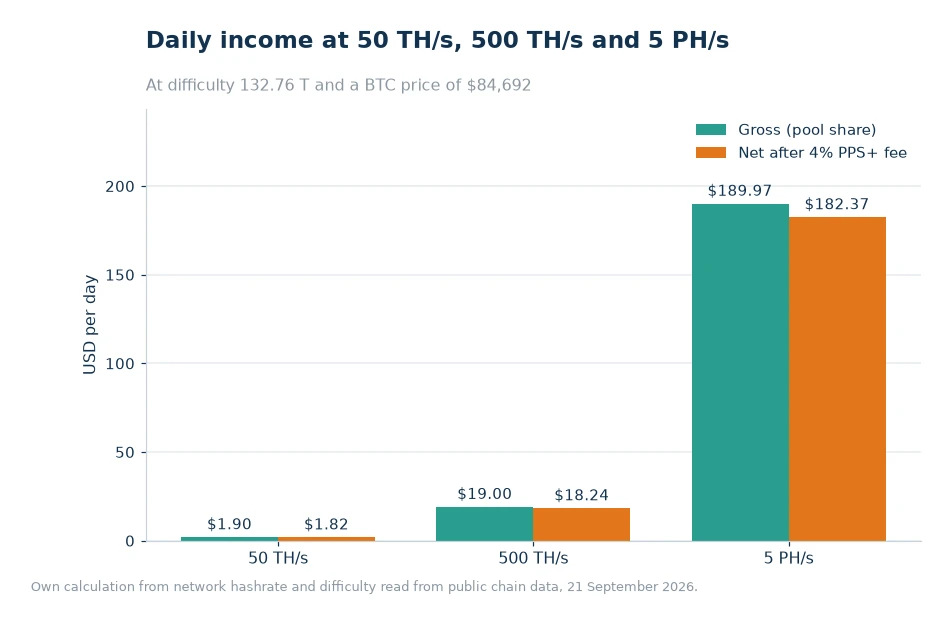
- A 5 PH/s rig earns 0.0022430 BTC ($189.97) a day against $144 of power at $0.06/kWh — a $45.97 daily margin that a one-point fee mistake can halve.
Context in 2026
The current network leaves very little room for sloppy assumptions. BTC difficulty is 132.76 T, network hashrate is about 1,003 EH/s, and the 3.125 BTC block subsidy across roughly 144 daily blocks puts 450 BTC — about $38.11 million — in front of every miner on the network each day. The next adjustment was estimated at -2.12% on the read date, which is a modest tailwind rather than a repricing.
Four of the five numbers are commercial terms, and commercial terms are exactly where a miner has leverage before signing anything. The fifth is physical: the efficiency of your hardware against the price you pay per kilowatt-hour.
| # | Check | Where the number comes from | Reference on 21 Sept 2026 |
|---|---|---|---|
| 1 | Listed fee per component | Pool pricing page and fee documentation | 4% PPS+ block reward, 2% transaction fees; PPLNS 2% combined |
| 2 | Settlement cadence | Pool terms of service | Hourly under PPS+; PPLNS after six confirmations |
| 3 | Payout threshold and withdrawal cost | Pool payout settings | Verify before committing small hashrate |
| 4 | Node latency to your site | Your own reject and stale-share rate | Measured per machine, not quoted by the pool |
| 5 | Break-even efficiency | Your power price and current output per TH/s | About 26.4 J/TH at $0.06/kWh; about 39.6 J/TH at $0.04/kWh |
The two variables that matter
The first is cost per unit of output. Divide your power price by income per TH/s and you get the efficiency limit: at $0.038 of daily income per TH/s and $0.06/kWh, a machine may consume at most 0.6333 kWh per TH/s per day, which is 26.4 W per TH/s. Anything less efficient than about 26 J/TH at that power price is running at negative gross margin.
The second is time on target. Rejected and stale shares are pure loss, and they are a function of round-trip latency between your site and the pool's node, not of your firmware. On a farm, a 1% reject rate on 5 PH/s is 50 TH/s of paid capacity burned.
Why the fee is two numbers
PPS+ splits the payout: the block-reward portion is settled per share at a listed 4% fee because the pool carries pool-luck and orphan risk, while the transaction-fee portion is distributed with PPLNS logic at a listed 2% fee.[1] Treating it as a single 6% haircut overstates the cost; treating it as 4% of everything understates it on fee-rich blocks.
Numbers from a real rig
A 5 PH/s rig of 20 J/TH machines draws 100 kW, which is 2,400 kWh a day and $144 of electricity at $0.06/kWh. Gross output at current difficulty is 5,000 × 4.486 × 10-7 BTC, or 0.0022430 BTC a day — $189.97 at $84,692. The margin is $45.97 a day, about $1,379 a month, before the listed fees on settled components.
Now move one assumption by one point. If the effective fee were 1 percentage point higher, about $1.90 a day of that $45.97 disappears — roughly 4% of the margin. If power were $0.07/kWh instead of $0.06, the bill rises to $168 a day and $24 of margin goes with it — more than half. Neither error shows up in a headline fee comparison, and both are checkable in advance.
Before committing hashrate, run the estimate in a tool that exposes every input rather than a single output: a profit calculator that accepts coin price, difficulty, fee rate and valid hashrate lets you test the two or three scenarios that matter and see which assumption the margin is hiding in.
Then confirm the operational side, which no calculator covers. A mining pool dashboard that reports per-worker hashrate, pool hashrate and settlement history is how you verify that the numbers you were quoted are the numbers arriving.
Decision guide
- Write the fee in components, not as a headline: block-reward part, transaction-fee part, and which method each applies under.
- Confirm cadence and threshold. Hourly settlement with a high threshold can still leave a small miner waiting weeks.
- Measure latency yourself. Run one machine for 24 hours and read the reject and stale rate before moving the fleet.
- Compute your break-even efficiency at your own power price, then decide whether the hardware still clears it at current difficulty.
- Recheck after each retarget. Retargets move output per TH/s, which moves the break-even line without changing your power contract.
Established operators tend to consolidate those checks on one platform, which is why service terms matter as much as the fee sheet: ViaBTC Bitcoin Mining publishes its fee components, hourly PPS+ settlement rule, calculator and statistics in one place, so the five numbers can be verified against documentation rather than inferred from a dashboard after the fact.
Frequently asked questions
Does the payout method change my average income?
It changes the variance and the fee, not the underlying expected value: your share of network hashrate still sets the ceiling.
How often should a miner check pool statistics?
Weekly is enough for cash flow, daily if you are reconciling worker uptime or chasing a hashrate fault.
What efficiency do I need for a rig to be viable?
At $0.06/kWh and current output of about $0.038 per TH/s per day, the power ceiling is 0.6333 kWh per TH/s per day, equivalent to 26.4 J/TH. At $0.04/kWh the ceiling rises to about 39.6 J/TH.
How do I know whether latency is costing me money?
Compare the effective hashrate the pool credits with the nominal hashrate the firmware reports. The gap is rejected and stale shares, plus the length of the pool's measurement window — a persistent gap is a routing problem.
Check the five, then commit
Do the arithmetic on paper before the fleet moves: fee per component, cadence, threshold, measured reject rate and break-even efficiency. Then verify the first day's settlement against your own estimate, using the difficulty and price from that same day. Miners who run these five checks rarely argue about headline percentages, because they already know which of the five is actually costing them money.
Data and sources: ViaBTC pricing page for the listed fee rates and settlement rules[1], ViaBTC calculator for hashrate and fee inputs[2] and ViaBTC mining statistics[3]. Network difficulty (132.76 T), network hashrate (about 1,003 EH/s), the 3.125 BTC block subsidy, the estimated -2.12% next adjustment and the BTC price of $84,692 were read from public chain data and market feeds on 21 September 2026. Figures are illustrative and change with difficulty and price.