
How to Evaluate an ODM Fragrance Supplier for a Kids-Safe Line
Evaluating an ODM fragrance supplier for a kids-safe line is a different exercise from choosing a factory for a standard launch, because the evaluation has to surface evidence, not promises. The five dimensions that matter are development depth, restriction awareness, packaging capability, documentation habit and communication discipline. Score each one with questions, and the supplier list shortens itself.
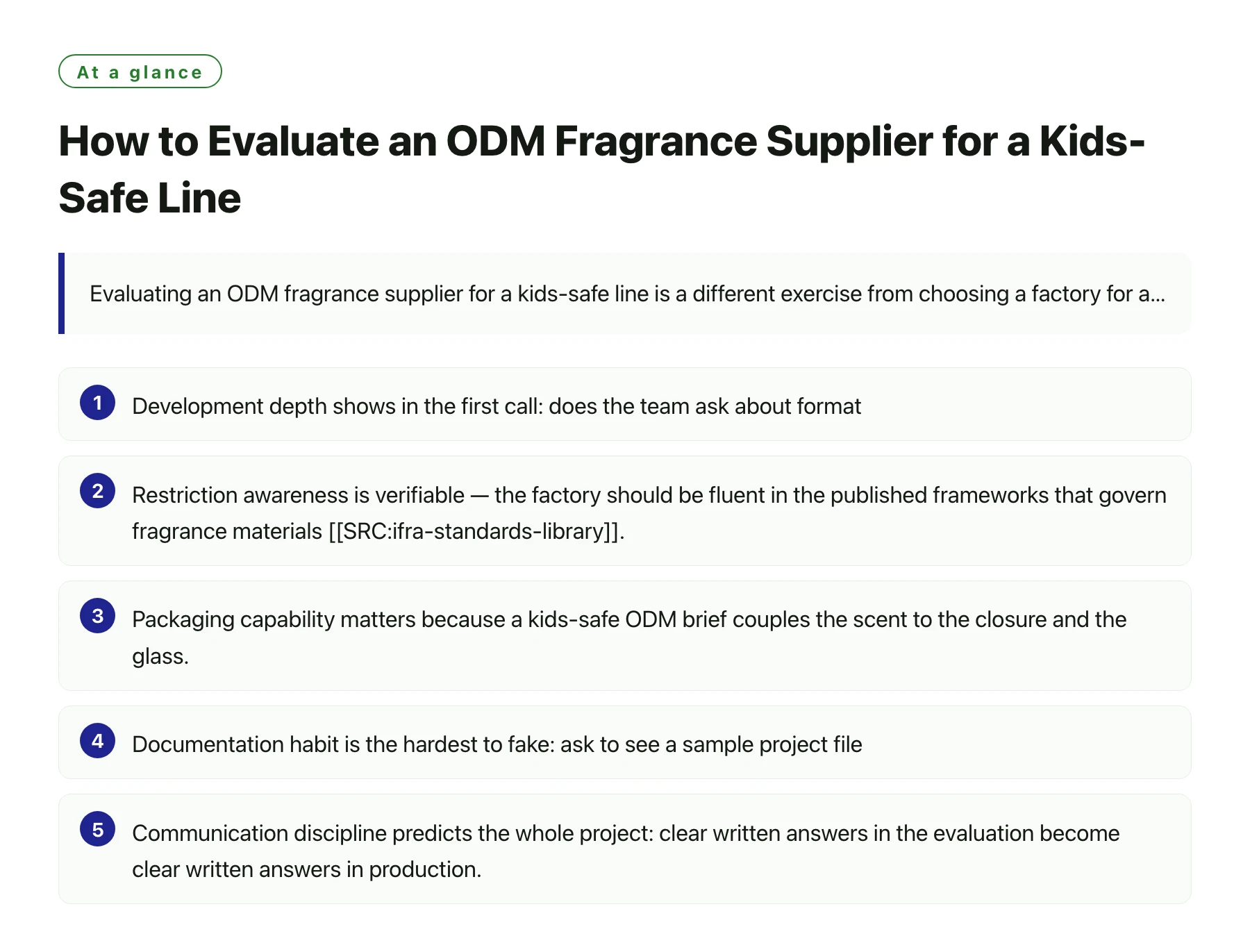
Key takeawaysDevelopment depth shows in the first call: does the team ask about format, markets and restrictions, or only about quantity? · Restriction awareness is verifiable — the factory should be fluent in the published frameworks that govern fragrance materials [1]. · Packaging capability matters because a kids-safe ODM brief couples the scent to the closure and the glass. · Documentation habit is the hardest to fake: ask to see a sample project file, not a description of one. · Communication discipline predicts the whole project: clear written answers in the evaluation become clear written answers in production.
In ODM, the manufacturer develops the scent from your brief — a model that hands the technical work to the factory and leaves the brand with positioning and distribution. That makes supplier selection unusually important: you are not buying a repeatable formula, you are buying a development team, and you will live with its habits.
The framework below scores suppliers on five dimensions. It is written for a kids-safe line, but the honest version is that these dimensions are the same ones a careful buyer would use for any ODM project — the safety angle just makes each one harder to fake.
The five evaluation dimensions
Run the evaluation as a structured conversation, not an impression. Each dimension below has a core question, and the supplier's answer — or refusal to answer — is the score.
1. Development depth
Ask how the team would approach your brief, and listen for structure: format questions, market questions, restriction questions, timeline questions. A team that asks only about volumes and fragrance family is quoting a catalogue, not developing a product. For a kids-safe line, depth also means asking you about the child's age range — the brief changes between a product for toddlers and one for pre-teens.
2. Restriction awareness
Fragrance materials are governed by published restriction frameworks — the IFRA standards, which set safe use levels and restrictions for fragrance ingredients and are the reference the industry cites [1]. Evaluate whether the supplier names these frameworks unprompted and can show their review of proposed materials for your brief. Fluency here is evidence; agreement without specifics is not.
3. Packaging and format capability
A kids-safe ODM brief couples the scent to the pack: the format constrains the formula (a balm behaves differently from a spray), and the closure constrains the safety case. Ask which formats the factory actually develops and fills in house, whether it stocks tested child-resistant closures, and how it handles the hand-off if packaging is sourced elsewhere.
4. Documentation habit
Ask for a sample project file — redacted if needed — and look at its shape: formula reference, ingredient review, stability plan, label checks, batch records. The file's existence is the evaluation. A factory that describes its documentation in the abstract is describing a brochure.
5. Communication discipline
Every question you ask during evaluation is a rehearsal of the project. Written, specific, dated answers predict production. Vague replies, phone-call-only explanations and 'we will handle that' predict the same behaviour at the worst possible moment — when a shipment depends on it.
Scoring sheet for the first meeting
| Dimension | The question to ask | Green flag | Red flag |
|---|---|---|---|
| Development depth | How would you approach this brief? | Asks about format, age range, markets | Asks about volumes and price only |
| Restriction awareness | Which frameworks govern my materials? | Names standards, offers the review | Reassures without specifics |
| Packaging capability | Which formats and closures do you run in house? | Lists formats, stocks tested closures | Defers every pack question to a third party |
| Documentation | Can I see a sample project file? | Shows a real, structured file | Describes documentation in general terms |
| Communication | How will decisions be recorded? | Written, dated, specific answers | Verbal assurances and open questions |
Score each row during the first meeting, not after. The sheet only works if you decide while the memory is fresh — 'seems fine' is not a score.
Reading the evidence behind the answers
The evaluation questions are deliberately simple; the reading of the answers is where the skill sits. A supplier fluent in restriction frameworks but vague on formats may be a formulator rather than a full ODM partner. A factory with strong packaging capability but a thin development bench may route your scent work through a freelancer — which is workable, but it changes who owns the knowledge.
For markets that follow the EU cosmetics framework, part of the evidence review means matching the supplier's safety vocabulary to the scientific assessment culture: ingredient safety questions there are shaped by the opinions of the EU's scientific committee on consumer safety, and a factory with real EU export experience will be comfortable in that conversation [2]. That comfort is what a dossier review feels like when it goes smoothly.
It is also worth asking the factory to show how it separates its ODM development service from its OEM work — their OEM/ODM manufacturing services usually sit under one roof with shared quality systems, and the line between them is exactly where ownership questions hide. And when you are comparing Chinese suppliers specifically, the practical filter is the same as anywhere: a Chinese factory for perfume brands (a Chinese factory for perfume brands) should be able to answer the scoring sheet without a follow-up meeting, because the sheet is only asking how it already works.
Finally, weigh the single most revealing item: the development team behind a factory that develops and produces the scent (a factory that develops and produces the scent) is the asset you are actually buying in an ODM project. Meet the perfumer or the development lead, not just the sales manager. The person who answers the restriction question in detail is the person your product will be built by.
If the supplier passes the scoring sheet but you still feel uncertain, the uncertainty is usually one unanswered question, not a feeling. Find it and ask it again in writing. ODM projects reward the buyer who can name the single thing that would change the decision.
Sources
- IFRA Standards Library (International Fragrance Association) —— The IFRA Standards Library lists the restrictions the fragrance industry applies to individual fragrance ingredients, based on safety assessments; it is the reference point for compliant fragrance formulation.
- EU Scientific Committee on Consumer Safety (SCCS) —— The EU scientific committee that issues opinions on the safety of cosmetic ingredients, including fragrance allergens and their labelling thresholds.
Frequently asked questions
What is the most important thing to check in an ODM supplier?
Whether the team can develop from a brief rather than push a menu. Ask how they would approach your specific product, then verify development depth, restriction awareness and documentation together — a factory strong on one and weak on the others will create problems at different stages of the project.
How do I verify a supplier's ingredient safety knowledge?
Ask which restriction frameworks govern the materials in your brief and request the review of proposed materials in writing. Fluency with published standards and the vocabulary of safety assessment is evidence; generic reassurance is not.
Should an ODM partner also handle packaging?
Not necessarily, but for a kids-safe line the format and closure choices shape the formula and the safety case, so the partner should at minimum be able to specify them competently and coordinate the suppliers. Full in-house packaging makes the hand-offs shorter and the audit easier.
How many suppliers should I evaluate before choosing?
Two or three serious evaluations is the practical range. Send the same scoring sheet and brief to each, compare the answers dimension by dimension, and resist the pull of the most impressive single answer — the sheet exists to keep the comparison whole.
What is the difference between evaluating for ODM versus OEM?
OEM means you bring the formula, so the factory's repeatability matters most. ODM means the factory develops the scent, so the development team and its safety habits matter most. The scoring sheet above is weighted for the ODM case; for OEM you would put batch records and process control at the top.
Specs on the page, turbos in the warehouse.
Cross-reference the part numbers above against our live Des Moines inventory — most orders placed before 2 PM CT ship the same day.